
Custom Boards
Custom Boards allows you to configure additional dashboards with a custom subset of sources and namespaces, selected via a list and/or label selector.
You can also configure filter and how you want to display your results to reflect the needs of the users.
INFO
We support the CustomBoard and NamespaceCustomBoard CRD since Policy Reporter UI v2.5.0. You need to opt in by setting ui.crds.customBoard to true in the Helm Chart (since v3.7.0)
The only difference between CustomBoard and NamespaceCustomBoard is that you can not set a namespace filter in NamespaceCustomBoard as always only show results for the namespace they are applied to. NamespaceCustomBoard also do not show cluster scoped results.
Short names: CustomBoard → cb, NamespaceCustomBoard → ncb :::
Cluster Filter
Restrict a CustomBoard to one or more configured clusters with the clusters field. Use the cluster slug values from the UI configuration, not the cluster display names. Matching is exact and case-sensitive. If multiple clusters are listed, the board is available on any of them. Omitting clusters or setting it to an empty list makes the board available on all clusters.
This field is supported for CustomBoard resources and static UI configuration. It is not available on NamespaceCustomBoard yet. On clusters that do not match, the board is hidden from navigation and its board-specific API routes return 404. Existing access controls still apply.
ui:
  enabled: true

  customBoards:
    - name: Production
      clusters: [production]
      namespaces:
list: [team-a]customBoards:
- name: Production
clusters: [production]
namespaces:
list: [team-a]kind: CustomBoard
apiVersion: ui.policyreporter.kyverno.io/v1alpha1
metadata:
name: production-board
spec:
title: Production
clusters: [production]
namespaces:
list: [team-a]Install the updated CustomBoard CRD before setting spec.clusters, so Kubernetes retains the field.
Namespace List
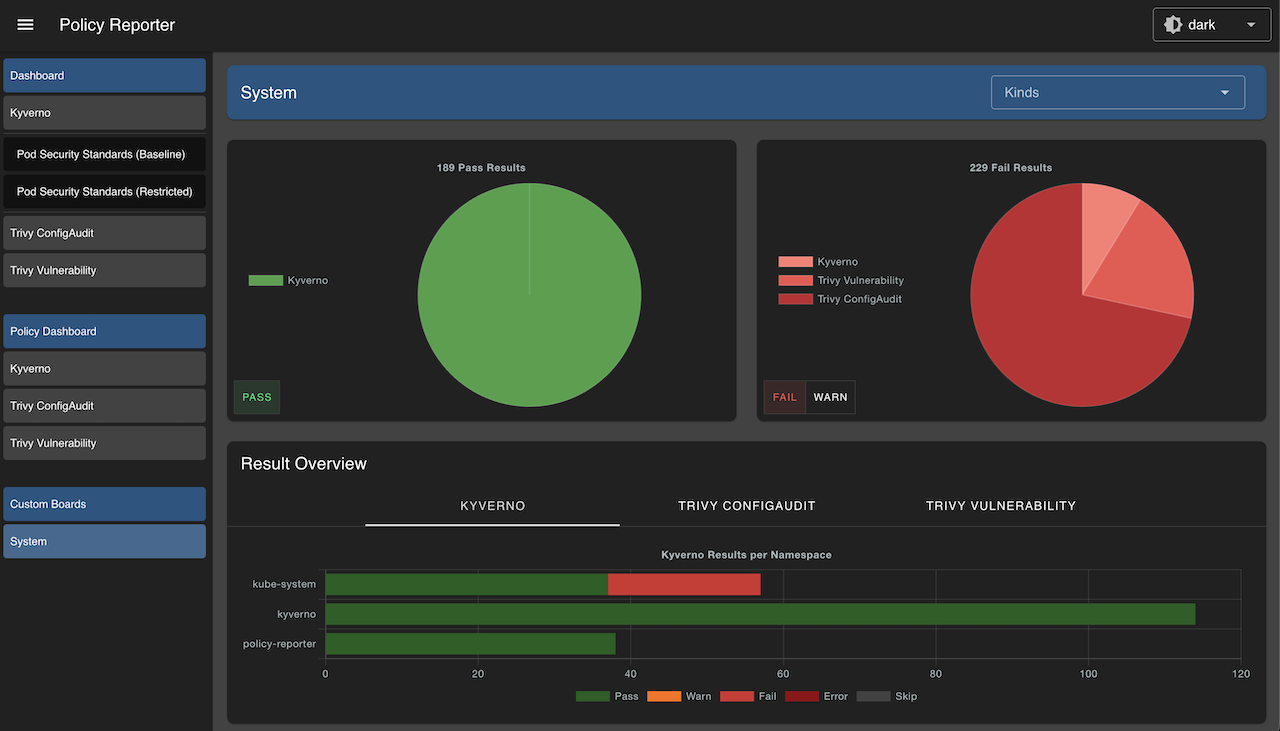
Basic Setup with a fixed list of namespaces.
ui:
  enabled: true

  customBoards:
    - name: System
      namespaces:
        list:
          - kube-system
          - kyverno
- policy-reportercustomBoards:
- name: System
namespaces:
list:
- kube-system
- kyverno
- policy-reporterkind: CustomBoard
apiVersion: ui.policyreporter.kyverno.io/v1alpha1
metadata:
name: kyverno-results
spec:
title: System
namespaces:
list:
- kube-system
- kyverno
- policy-reporterkind: NamespaceCustomBoard
apiVersion: ui.policyreporter.kyverno.io/v1alpha1
metadata:
name: policy-reporter
namespace: policy-reporter
spec:
title: Policy Reporter
sources:
list: [kyverno]Screenshot
Namespace Selector
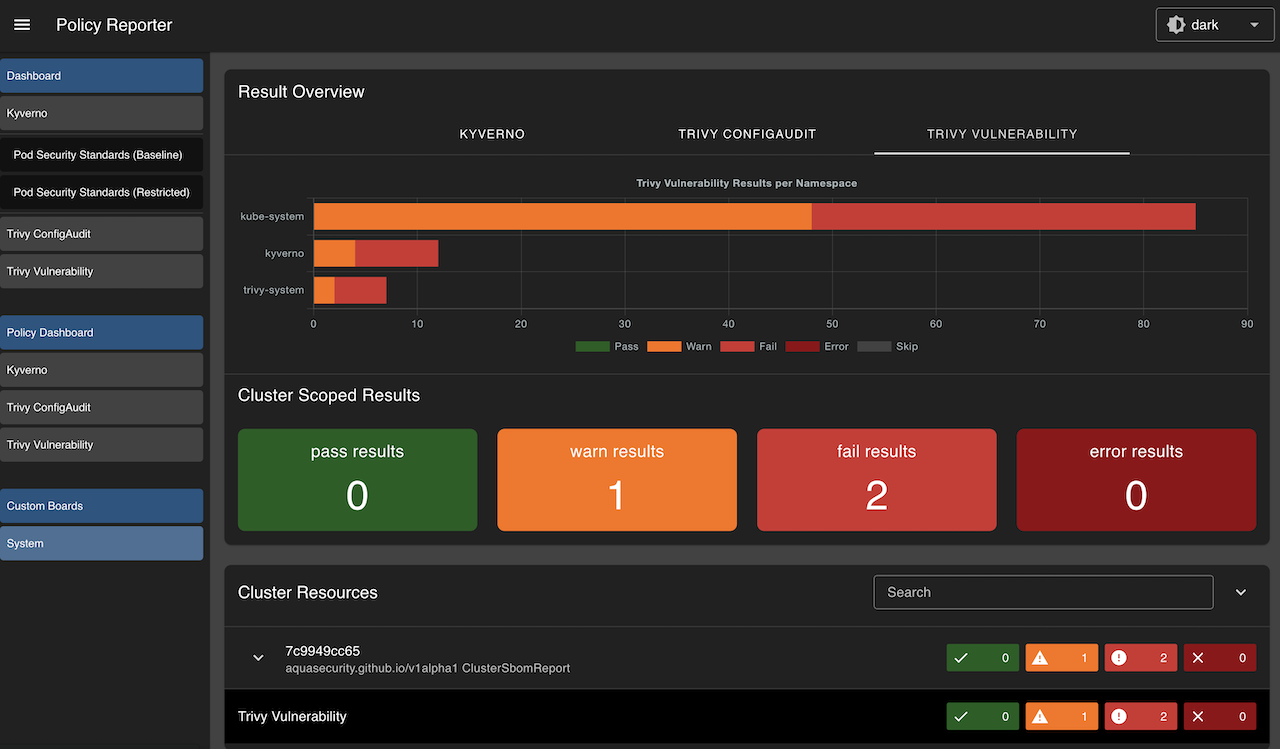
Setup a flexible list of namespaces by using a namespace label selector. Label selectors supporting different operations like equal, exists, one of and doesnotexist.
ui:
  enabled: true

  customBoards:
  - name: System
    namespaces:
      labelSelector:
        group: system          # equal check
        app: '*'               # label exists
        service: '!*'          # label does not exists
tools: 'kyverno,falco' # label tools is one of the defined values: [kyverno, falco]customBoards:
- name: System
namespaces:
labelSelector:
group: system # equal check
app: '*' # label exists
service: '!*' # label does not exists
tools: 'kyverno,falco' # label tools is one of the defined values: [kyverno, falco]kind: CustomBoard
apiVersion: ui.policyreporter.kyverno.io/v1alpha1
metadata:
name: system
spec:
title: System
namespaces:
labelSelector:
group: system # equal check
app: '*' # label exists
service: '!*' # label does not exists
tools: 'kyverno,falco' # label tools is one of the defined values: [kyverno, falco]Screenshot
Source List
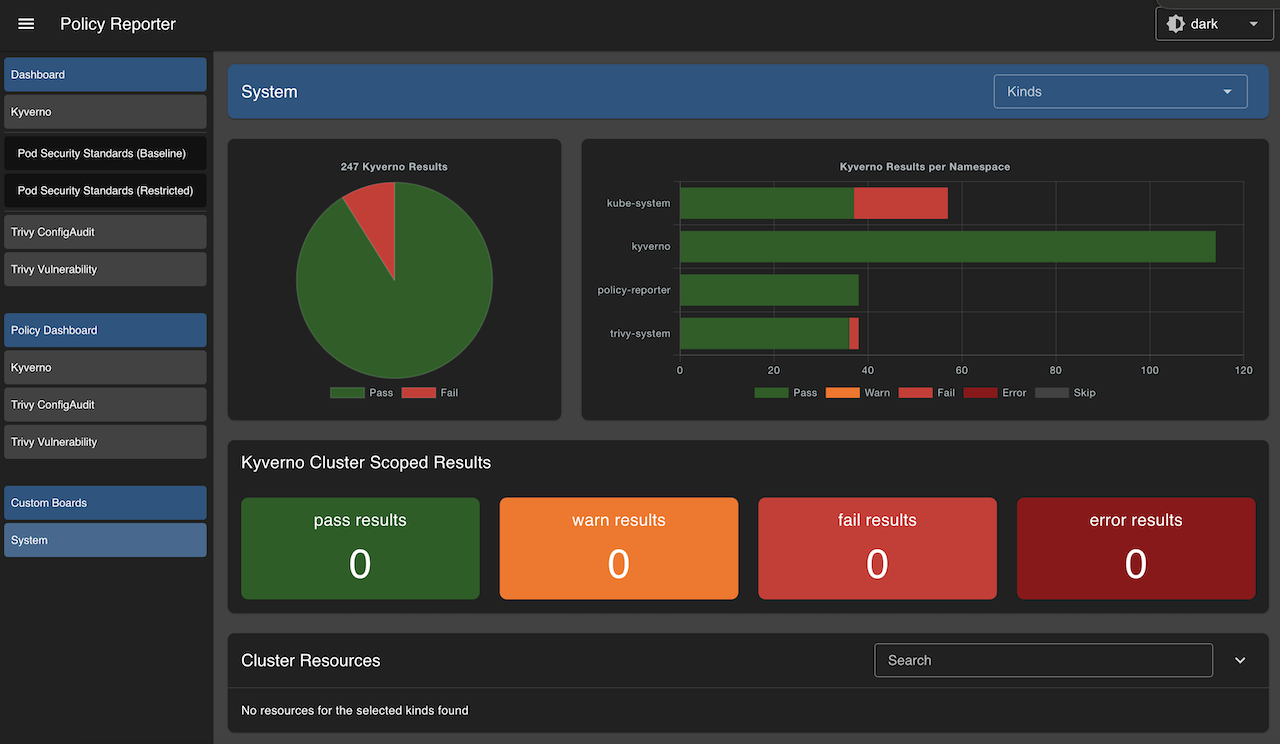
Restrict the displayed sources.
ui:
  enabled: true

  customBoards:
  - name: System
    clusterScope:
      enabled: true
    namespaces:
      labelSelector:
        group: system
    sources:
list: [kyverno]customBoards:
- name: System
clusterScope:
enabled: true
namespaces:
labelSelector:
group: system
sources:
list: [kyverno]kind: CustomBoard
apiVersion: ui.policyreporter.kyverno.io/v1alpha1
metadata:
name: system
spec:
title: System
namespaces:
labelSelector:
group: system
sources:
list: [kyverno]Screenshot
Filter
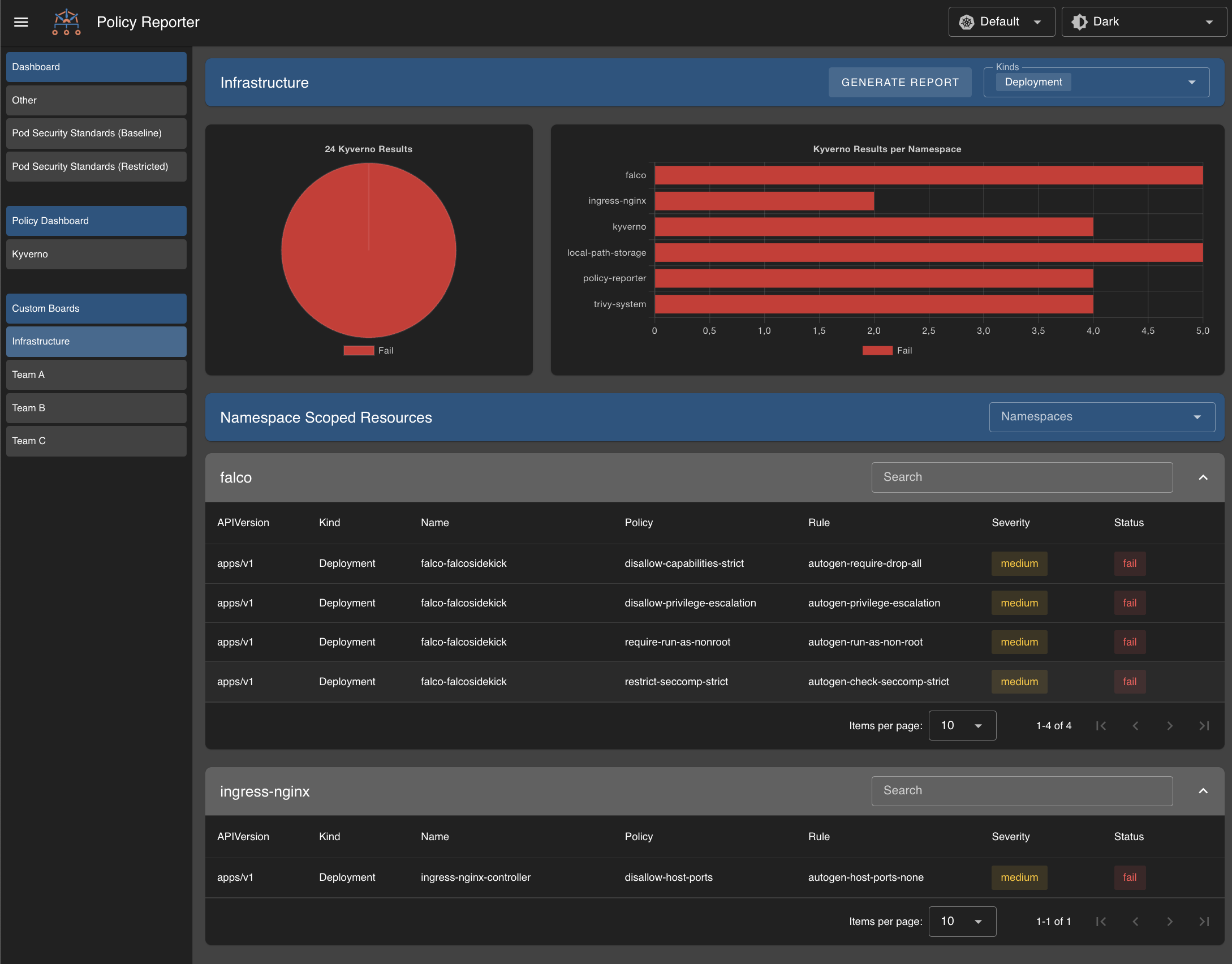
Filters can be used to reduce displayed information to the needed minimum. Both include and exclude filters are supported. You can set a results, namespaceKinds, clusterKinds, resources and clusterResources filter.
Example
Configure a filter to only show fail results of your Deployment in all namespaces with a group:system label, produced by kyverno.
ui:
enabled: true
customBoards:
  - name: System
    clusterScope:
      enabled: true
    namespaces:
      labelSelector:
        group: system
    sources:
      list: [kyverno]
filter:
results:
include: [fail]
namespaceKinds:
include: [Deployment]customBoards:
- name: System
clusterScope:
enabled: true
namespaces:
labelSelector:
group: system
sources:
list: [kyverno]
filter:
results:
include: [fail]
namespaceKinds:
include: [Deployment]kind: CustomBoard
apiVersion: ui.policyreporter.kyverno.io/v1alpha1
metadata:
name: system
spec:
title: System
namespaces:
labelSelector:
group: system
sources:
list: [kyverno]
filter:
results:
include: [fail]
namespaceKinds:
include: [Deployment]Available Filter Fields
| Field | Description |
|---|---|
results | Filter by result status (pass, fail, warn, error, skip) |
namespaceKinds | Filter namespace-scoped resources by kind |
clusterKinds | Filter cluster-scoped resources by kind |
resources | Filter by specific namespace-scoped resource names |
clusterResources | Filter by specific cluster-scoped resource names |
Each field supports include and exclude lists. include limits results to the listed values; exclude removes results matching the listed values.
Display
Deprecated
The display field is deprecated in favor of renderOptions.resultView. It will be removed in a future version.
The new UI shows the results grouped by resources in all automatically generated dashboards and by default in custom boards. For users who prefer the old visualization, it is possible to set display to results. In this mode, the dashboard will instead display a table with all results in the specified namespaces.
Example
ui:
  enabled: true

  customBoards:
  - name: System
    display: results
    clusterScope:
      enabled: true
    namespaces:
      labelSelector:
        group: system
    sources:
        list: [kyverno]
    filter:
      include:
        results: [fail]
namespaceKinds: [Deployment]customBoards:
- name: System
display: results
clusterScope:
enabled: true
namespaces:
labelSelector:
group: system
sources:
list: [kyverno]
filter:
include:
results: [fail]
namespaceKinds: [Deployment]kind: CustomBoard
apiVersion: ui.policyreporter.kyverno.io/v1alpha1
metadata:
name: system
spec:
title: System
display: results
clusterScope:
enabled: true
namespaces:
labelSelector:
group: system
sources:
list: [kyverno]
filter:
results:
include: [fail]
namespaceKinds:
include: [Deployment]Screenshot
Render Options
renderOptions replaces the deprecated display field and provides additional rendering configuration. It is supported since Policy Reporter UI v2.7.0.
resultView
Controls how results are displayed within the board. Defaults to resources (grouped by resource). Set to results to display a flat results table instead.
dashboardMode
Controls the dashboard layout. Defaults to detailed. Set to compact for a condensed view with less visual spacing — useful when many namespaces or resources need to be shown at a glance.
Example
kind: CustomBoard
apiVersion: ui.policyreporter.kyverno.io/v1alpha1
metadata:
  name: system
spec:
  title: System
  renderOptions:
    resultView: results
    dashboardMode: compact
  namespaces:
    list:
      - kube-system
      - kyverno
- policy-reporterkind: NamespaceCustomBoard
apiVersion: ui.policyreporter.kyverno.io/v1alpha1
metadata:
name: policy-reporter
namespace: policy-reporter
spec:
title: Policy Reporter
renderOptions:
resultView: results
dashboardMode: compact
sources:
list: [kyverno]Access Control
accessControl restricts who can view a custom board. It is mutually exclusive: specify either emails or groups — not both. This is only effective when authentication (OAuth2/OIDC) is configured.
INFO
accessControl is supported since Policy Reporter UI v2.5.0.
Example
kind: CustomBoard
apiVersion: ui.policyreporter.kyverno.io/v1alpha1
metadata:
  name: kyverno-results
spec:
  title: Kyverno Results
  namespaces:
    labelSelector:
      kubernetes.io/metadata.name: '*'
  sources:
    list: [kyverno]
  accessControl:
    groups:
      - platform-team
- security-teamkind: NamespaceCustomBoard
apiVersion: ui.policyreporter.kyverno.io/v1alpha1
metadata:
name: fail-board
namespace: kube-system
spec:
title: Kube System Failures
display: results
sources:
list: [kyverno, KyvernoValidatingPolicy]
filter:
results:
include: ["fail"]
accessControl:
emails:
- admin@example.comPolicy Report Selector
policyReports allows filtering which PolicyReport or ClusterPolicyReport resources are visualized on the board, using a Kubernetes label selector.
Example
kind: CustomBoard
apiVersion: ui.policyreporter.kyverno.io/v1alpha1
metadata:
  name: kyverno-results
spec:
  title: Kyverno Results
  namespaces:
    list:
      - kube-system
      - kyverno
  policyReports:
    labelSelector:
      app.kubernetes.io/managed-by: kyverno